
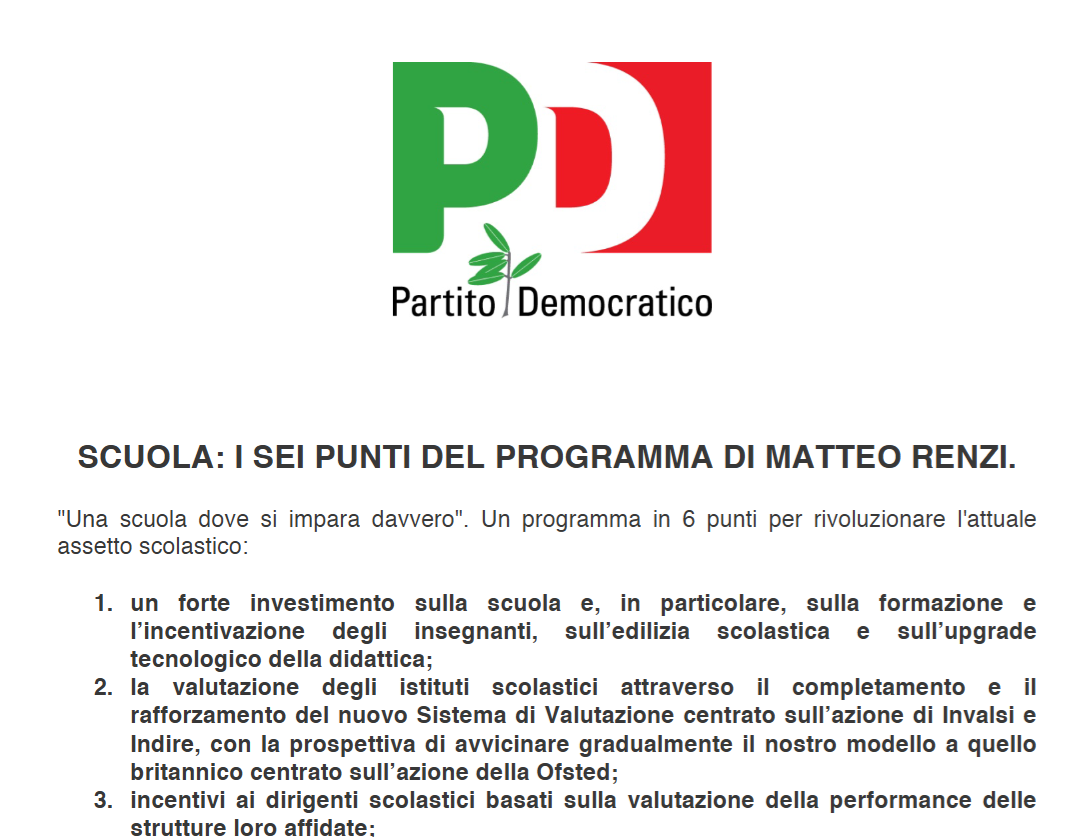
It is a historic moment for the school. Or at least that's how the Minister of Education and Merit Valditara defines it. "Money tied to results," the newspapers headline. In fact, the "historicity" of the moment is only a matter of money. Not additional funding for schools to guarantee their basic functioning (and perhaps the availability of toilet paper), of course. But cash prizes for school principals, which will be distributed based on merit. And how is merit measured? Based on INVALSI results. Finally, with the report cards for school principals essentially entrusted to INVALSI, Valditara completes the PD Renzi program on schools. It is a historic moment for the school. That's how the Minister of Education and Merit defines it. A moment that will deserve to be passed down to posterity and that will influence the future of education. Finally, the report cards for school principals arrive: "money tied to results."
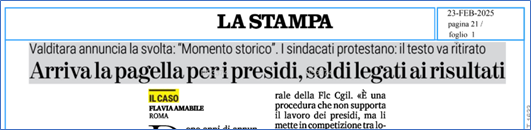
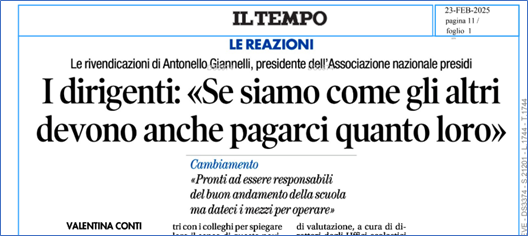
The “historicity” of the moment Valditara talks about is linked to money. In fact, although a procedure for evaluating school principals is already underway, the results of the evaluation were not linked to performance pay, which has, until now, been paid to everyone. So, if we interpret the matter correctly, what the Minister considers “historic” is cutting the pay of those principals who are evaluated worse than others. In short, as we know, merit is paid for, and moreover, it is measurable, not the function. Reactions were not long in coming. The favorable positions of some professional associations stand out, particularly the National Principals Association. President Giannelli takes the opportunity to push further. Principals have been waiting for years for a serious evaluation: they are “ready to be responsible for the proper functioning of the school,” but then they want a “harmonization” of their salaries.
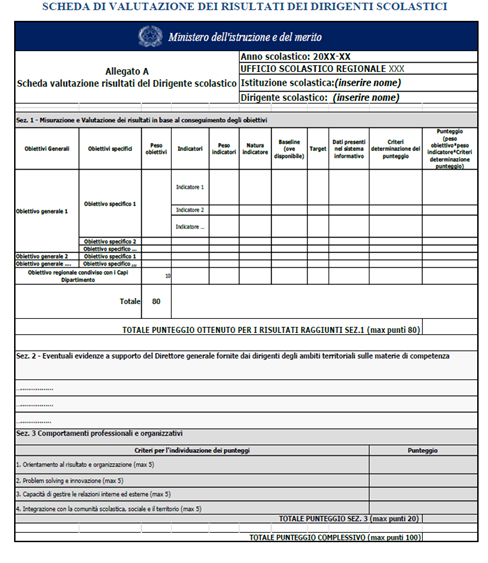
Apparently, it is not enough that “today the school principal earns 72% more than any other graduate, and 100% more than one of their teachers”, thus guaranteeing Italy “two opposite records: the worst paid teachers and the highest paid school heads” (see the highest paid (or almost) school principals in Europe). The new report card for principals must become a good opportunity for new economic demands. As the leaders of the professional association dirigenti.scuola write, in fact: “Absolutely inadequate salary and disproportionate compared to the management of any other state administration, which instead enjoys benefits, reimbursements, business trips, housing allowances, meal vouchers, compensatory rest, smart working and so on, without however having to manage a thousand small users, and therefore about 2,000 parents (today all stakeholders and potential sources of litigation, always just around the corner) as well as of course the hundreds of employees including teachers, administrative staff and collaborators.” Evaluation, as always, is an excellent bargaining chip: if you do not oppose the imposed evaluation, indeed you demand it loudly, you show yourself to be responsible; then the collaboration must be rewarded with economic and power incentives. “Give us the means to operate,” says the ANP president, brandishing the association’s old workhorse, which has long been asking to eliminate “bureaucratic constraints,” “ties and bonds,” “organizational obstacles” that limit the decision-making power of principals. On the other hand, the evaluation of principals can only be a: “preparatory operation for the evaluation of all school staff, about a million employees.” Another favorite topic: evaluate everything and everyone, preferably with a hierarchical touch (regional managers evaluate school principals, who evaluate teachers...) and on the basis of clear and comparable results. What are these measurable “results” on which principals will be evaluated? Let’s scroll through the ministerial directive by Valditara of February 21, “Adoption of the National System for the Evaluation of the Results of School Principals”, previously rejected by the Higher Council of Public Education. We read that: “The System for the evaluation of the results of School Principals is aimed at an objective and transparent evaluation of the individual results achieved by School Principals on the basis of clearly defined and measurable objectives..” And that the evaluation will take place through (yet another) platform, “on the basis of the tools and data available in the Ministry’s information system,” by means of an “evaluation process divided into several phases” and with precise timing: The assigned objectives will be “broken down into measurable indicators and targets”; each target will be “challenging but achievable.” The directive is accompanied by the model “report card” for principals, divided into two sections. The first: “Measurement and evaluation of results based on the achievement of objectives” (up to 80 points) and the second, relating to “professional and organizational behaviors” (up to 20 points). How “results-oriented” is the principal? How dedicated are they to “problem solving and innovation,” are examples of behaviors evaluated.But what results?
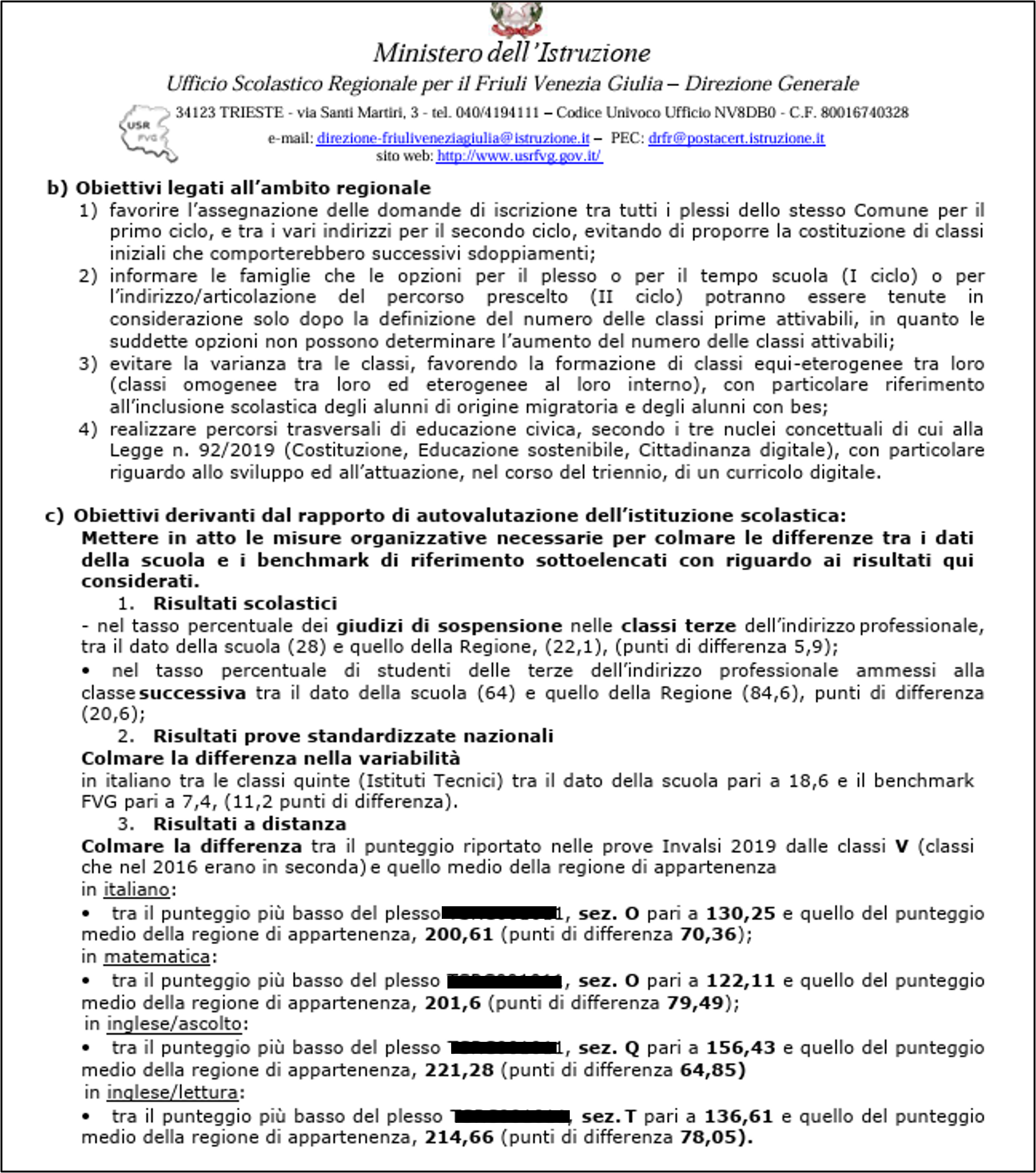
The report card represents yet another accounting trivialization of work in schools, yet another form that tries to capture the fragments of a profession in discrete units, complete with “weights” for objectives and indicators (established beforehand), evidence, multiple cells that give the document a pompously scientific aura, according to ministerial logic; bitterly Kafkaesque, in our view. It is another arbitrary quality control procedure, which describes a complex profession with an abstract and objectifying scheme. And at the moment it does so, it imposes a precise relationship to work, forcing principals to submit to the established rules even more than they already do. We do not yet know what the various “objectives” will be, whether national, regional, or connected to the context of the individual institution. However, we do have access, online, to some very significant examples of “managerial objectives” assigned so far to principals by various regional school offices. Reading them helps to recall what predictable trend has taken hold over the years, starting from the implementation of the continuous quality control cycle of the National Evaluation System, based essentially on the data produced by INVALSI. In the following photos, for example, we show excerpts from the appointment letters of various school principals, with some lists of managerial objectives. In addition to the national strategic ones (ensuring the unified direction of the school, promoting participation and collaboration...), we find regional objectives (informing families, forming homogeneous classes...) and those derived from the evaluation processes of individual school realities, which are worth focusing on. While the first two are expressed in a “discursive” form, the specific objectives are quantified numerically. In the Friuli Venezia Giulia model, for example, we notice that the objectives resulting from the evaluation process are strictly quantitative – down to the first decimal (!) – and require meticulous alignment with the territorial benchmarks assigned by INVALSI. The test scores stand out, obviously to be increased, even broken down by sections and school complexes.Some examples of managerial objectives
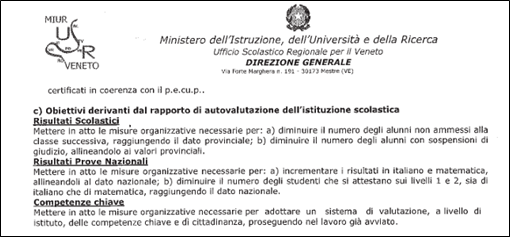
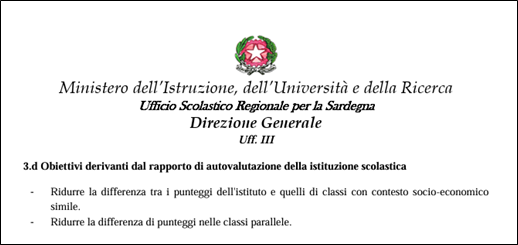
In Veneto the situation is similar; the letter is less detailed. Here too, among the "context" objectives, we find the request to "implement the necessary organizational measures to increase test results", aligning them with the regional benchmark.
If we move geographically away from the Austro-Hungarian spirit and arrive in Sardinia, the style changes, but not the substance.
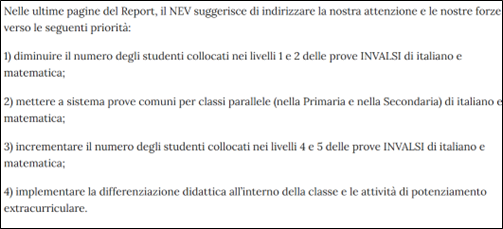
It really seems that, when it comes to quantifiable and comparable objectives for Italian school principals, there is little else besides the “scores” and standardized “indices” of INVALSI. According to ministerial logic, which Valditara reiterates when he talks about “objective evaluation based on measurable goals,” a principal will be considered good if they can demonstrate actions that increase their students’ test results, if they align with or surpass the imposed territorial benchmarks, if they increase the “added value” of their school, which INVALSI calls the “school effect.” To do this, they must use the tools at their disposal: their leadership, as we say today, their imposing ability, as we would have said yesterday. The fact that, when talking about “quantifiable” and “incrementable” indices, INVALSI scores immediately come to mind is not just an obsession of those who oppose merit. If we read this interesting report produced by a comprehensive school in Lombardy, we discover what the external evaluation procedure conducted by the (so-called) External Evaluation Units (NEV) with the “experts” trained by INVALSI actually consists of today. What was the diagnosis of the “quality” of the school visited by the NEV essentially based on? What “remedy” followed the diagnosis? The answer is what we imagine: “primarily on the analysis of the results of the INVALSI tests (Italian, mathematics, and English).” To overcome the inefficiencies found, one must “better focus attention,” set the right “priorities,” carry out “common parallel tests,” and increase the percentages. We could sum it up in 4 words: TEACHING – TO – THE – TEST.The usual elephant in the room: the INVALSI “data”
The reforms and the logic of the PNRR will only exacerbate this tendency, strengthening the procedures of quantification and bureaucratic reporting. Damiano Previtali, a “historic” official of the school administration, for many years head of the evaluation office, also carrying out roles of collaboration with INDIRE and INVALSI, writes: “with the disproportionate increase in resources, everything is resolved in administrative documentation and controls, without evaluating the actual impact or reducing everything to only standardized national surveys.” The “historic” moment Valditara speaks of will not escape this consideration. But it will make it more aggressive, because the evaluation competition will end with a cash prize and not just a reputational one. Valditara thus completes the Renzi PD program on schools (2012):