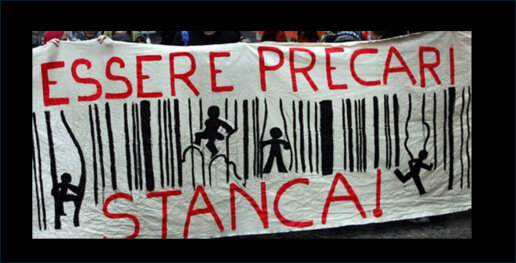
Over the past decade, the number of precarious teachers in Italy has grown out of all proportion, reaching around 234,500 in 2024, a quarter of all teaching positions in schools. Yet, the full extent of this figure is still not fully understood, especially since it does not include colleagues who have received short-term substitute assignments. School precariousness, in addition to being a problem for teachers, is also and above all a problem for students, deprived of educational continuity and important reference figures in their growth, with significant repercussions in terms of school dropout rates. Within an already problematic framework, the reform introduced by decree law 36/2022, known as the Bianchi reform, has established new rules for the initial training of teachers. The most important innovation is the introduction of university courses of 60, 36, and 30 CFU, to obtain qualification and thus registration in the first band of the Gps, but not stabilization. The implementing decrees of the reform, however, have made these courses inaccessible on three levels: It is therefore clear the discriminatory nature of the criteria for accessing these courses, with the aggravating factor of having given priority to those already in possession of a qualification in a different competition class or in support. Moreover, these courses, while not precluding inclusion in Gps, will be mandatory from next year for registration in teaching competitions. This has triggered a real race for qualification, which has further fragmented the already divided category of precarious school workers. It is important to underline that before our eyes a classist access system is taking shape, in which those who have more money to spend on one or more qualifications are advantaged, in defiance of the much-vaunted “merit.” The experience of those who have attended these courses is symptomatic of their usefulness: with a few exceptions in terms of teachings and universities, these courses have been described as useless and redundant. We are therefore faced with a type of summative training, rather than truly instructive, or, to put it differently, yet another qualification to buy to avoid falling behind in the rankings, with the risk of not working. So, who are these qualification courses really for? They are certainly not necessary for those teaching for the first time, who, while excluded from the limited number, could still be given a fixed-term contract, even without any specific training behind them. Nor are they necessary for those already teaching who, rather than training, are forced to buy a piece of paper of questionable value. They certainly serve the universities, both online and state. The former, year after year, increase their turnover by profiting from precarious workers; the latter do not disdain an additional income in the face of the continuous cuts they suffer. Faced with such a situation, precarious workers feel frightened and blackmailed. Frightened because not enrolling in qualifying courses could cost them an annual substitute assignment. Blackmailed, because not being qualified means being overtaken by colleagues who have meanwhile obtained the qualification. As if that were not enough, this reform fits into a scenario already heavily characterized by an unworthy trade in qualifications, with precarious and aspiring teachers subjected to strong economic pressures to add points for the Gps. With the qualifying courses, this mechanism takes a further step forward: a qualification no longer offers just a score, but registration in the first band, with all the related work advantages. The first and natural consequence of this has been the fragmentation of precarious workers, divided by particular interests: long-term precarious against support colleagues, three-year contract holders against recent graduates, those qualified through competition against those qualified through courses. Such Balkanization has only facilitated a policy that finds it easy to divide a teaching body often already largely anesthetized. Divided internally, precarious workers receive even less support from tenured teachers, who should in fact show solidarity with colleagues with whom they share classes and staff meetings. The situation does not improve if we look at the political class or the major unions. The issue of precariousness, in fact, has for too long not been on the agenda at the round tables of the various governments that have followed one another, and only recently is it slowly making its way into some assemblies. In a climate of general acceptance of precariousness as a modus operandi of the private sector, society as a whole seems to have internalized the goodness of this model even for the public sector. What is not understood is that when introduced into the education system, precariousness damages it from within, weakening it and making the transmission of knowledge less effective. Reversing course is not easy. In a context of continuous cuts, schools and research constantly see their resources eroded. However, convergence among all precarious education workers is not only necessary, but now seems imperative. It is not only the rights of workers that are under attack, but the education system itself. It is not just a class problem but a foundational issue for a healthy society. What should unite us is a firm condemnation of a classist and discriminatory system; of the continuous commodification of knowledge; of the abuse of fixed-term contracts in schools and universities, and the loud demand for effective and well-defined stabilization paths. It is not just us who are made precarious, it is culture itself that is being made precarious, and culture cannot and must not be precarious.
Search in the Blog
Privacy Policy
I precari della scuola e la riforma del Ministro Bianchi
I precari della scuola e la riforma del Ministro Bianchi
08-04-2025 06:59
08-04-2025 06:59
Array( [90203] => Array ( [author_name] => author [author_description] => [slug] => )) no author 90588
Privacy Policy