This post returns to the topic of soft skills at school, the Big Five model, and the idea that it is possible to mathematize and measure students' "character traits," preferably as early as possible, because "socio-emotional skills" are malleable and can be modified by intentional educational interventions. Started internationally, these new standardized surveys have also arrived in Italy, in some selected sample schools of INVALSI, on 11-year-old students. We are told that measuring soft skills, also thanks to new digital technologies, will contribute to promoting the physical and psychological well-being and professional success of our students. And that these measures will also improve the equity of our education system. We, on the other hand, think that collecting data on character skills and building a public database on students' "non-cognitive traits" to "make available to public and private actors" is not a good idea at all. Even if for now it is a pilot project, thehistory of INVALSI tests has taught us that an entire measurement system can arise from a small experiment. The new experimental project of INVALSI is called ENRICH, which stands for: Evaluating non cognitive skills for Resilience Innovation and Change. Another acronym that arrives in schools, specifically in lower secondary schools, first-year classes, children of 11 years old and will involve the standardized measurement of some "socio-emotional skills." The experiment was born from a collaboration, and was presented to the public last September 27 (here the link to the webinar and here the links to the presentations). Other details were then provided to the interested schools (here).
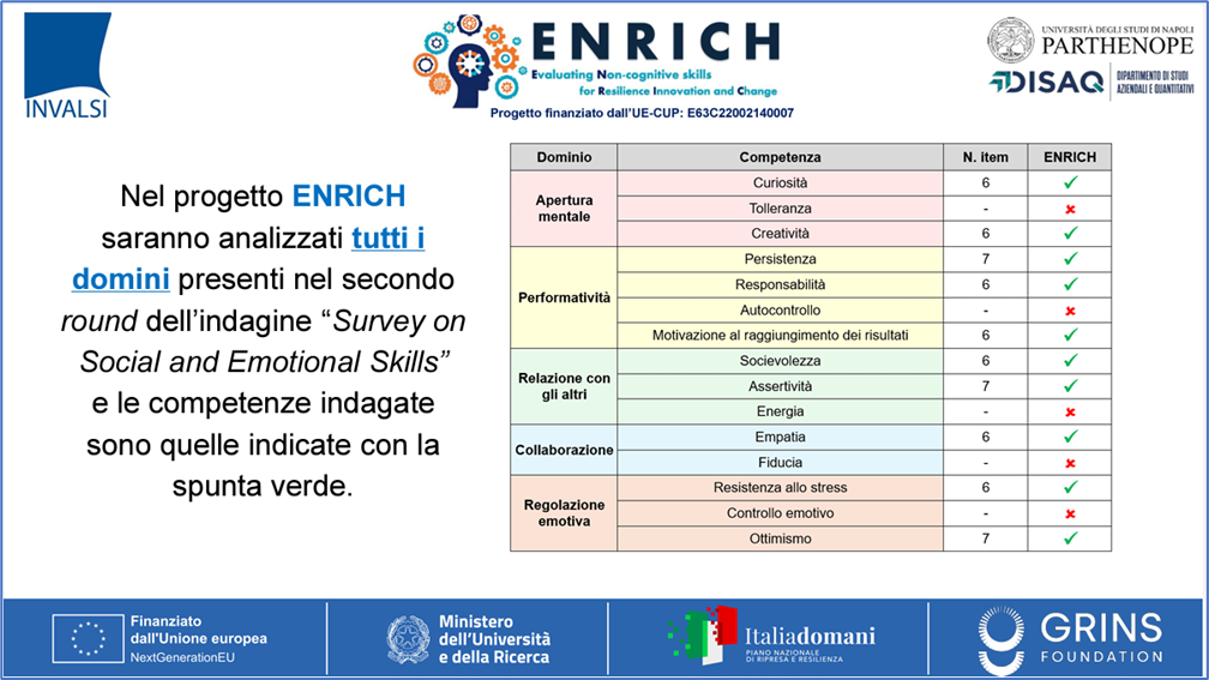
INVALSI defines it as a “pilot survey”, part of a macro-project called GRINS (Growing resilient, inclusive and sustainable), which is an “extended partnership” between public and private entities under the PNRR, whose objective is the development of: “an integrated set of heterogeneous geo-referenced databases for the study of the economic and social conditions of Italian territories and the economic system” to be “made available to public and private actors”. Starting from this data, it will be possible to generate usable, transferable, and searchable knowledge also thanks to Artificial Intelligence. What do the “character skills” of first-year middle school students have to do with this? From the presentation, we learn that INVALSI will deal with the section relating to “Integration of School-University-Work Data” and: It is “fundamental to build a database of unstructured data [..such as..] non-cognitive traits or population expectations, which are generally the subject of surveys, limited in time and carried out by private entities” that is, data that cannot be investigated through official statistics, such as ISTAT or administrative data. Having a public database would allow to: “overcome the privacy issues that make it difficult to match different datasets and statistics.” This is what Giorgio Vittadini, President of the Fondazione per la Sussidiarietà, already founder of the Compagnia delle Opere, states in his speech. We are therefore facing the construction of a new digital infrastructure, capable of interacting with other databases and generating information starting from different indicators, including the test scores on both cognitive and non-cognitive skills of our students, measured by INVALSI. The type of data collected is therefore expanding, adding to the so-called “hard skills” (math, English, Italian) also the “soft skills”, “character virtues”, in order to better outline the profiles of the individuals being tested. And to start, a small segment of the school population will be involved. The ENRICH survey will be sample-based and will target: 11-year-old students attending the first year of middle school in selected schools in different geographical areas, although schools that wish to participate with all classes of the institute, outside the sample, will be given the opportunity. This is a choice already made by the institute in the past, not insignificant, because it helps to build a “normalization” of the measurements carried out. ENRICH, following the example of OECD surveys, will be based on questionnaires administered digitally through the Limesurvey platform. After data collection, cleaning and review, and dataset generation, there will be analysis, reporting, and distribution in schools. The final phase will be dissemination, construction of articles, reports, and conferences. The expected end is December 2025. Online it is possible to find some school circulars from participating schools (here, for example) and the information notice on data processing. There is currently no detailed information. What we know from the webinar is that INVALSI will follow the path of the international survey on Socio Emotional Skills of the OECD (which we already discussed on this blog) based essentially on the so-called Big-Five Model, the 5 key factors recurring in the psycho-econometric literature: conscientiousness, extraversion, emotional stability, openness, agreeableness. At the basis of the OECD surveys is the assumption that personality data, collected on a large scale, are predictive of the potential social and economic progress of a country and that socio-emotional learning represents a didactic revolution, increasingly personalized, thanks to the use of technologies and educational platforms. Precisely the Fondazione per la Scuola, Compagnia di San Paolo [1], present at the conference, is funding the OECD international survey (Survey in Social and Emotional Skills) on samples of 10- and 15-year-old students from the Emilia Romagna and Piedmont regions [2], now in its “third round”. In the information seminar, the theoretical framework (borrowed from the OECD framework) is shared, in which the skills to be measured are indicated with a green check.1) What is ENRICH, what is the role of INVALSI and what are the objectives
2) The Socio-Emotional Skills Framework: little clarity and conceptual confusion
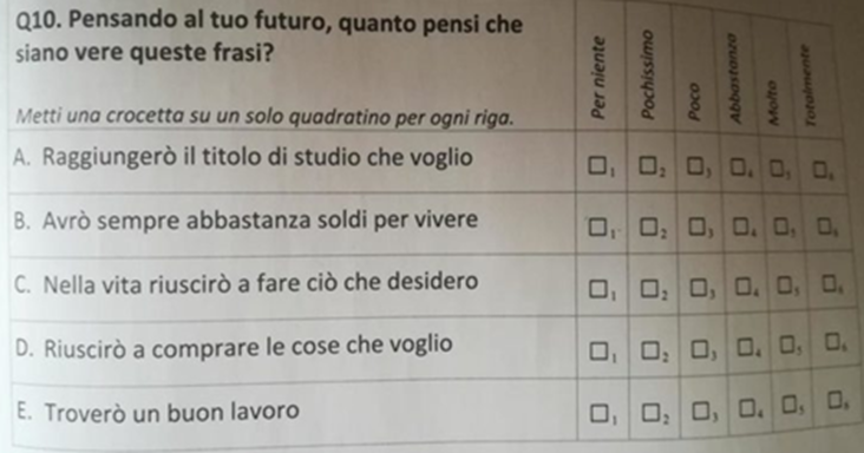
No definition is given, no further explanation of the investigative tools that will be used. In another document, called “La restituzione dei risultati alle scuole”, available online, we can find some additional descriptors or indicators of the taxonomy chosen by the Institute. For example, we learn that the measurement of the “open-mindedness” of the children surveyed is the combination of “curiosity competence” (learning new things and discovering how they work) + “creativity competence” (attitude to exploration, intuition, original solutions); that the “performativity” of students will be a combination of “persistence competence” (completing activities) + “responsibility competence” (keeping commitments, punctuality, reliability); that the measurement of “emotional regulation” in children will depend on “stress resistance competence” (ability to modulate anxiety, calmly solve problems) + “optimism competence” (positive expectations about oneself and life). And so on. The lack of definitional clarity does not depend on the speakers, INVALSI officials, university professors or foundation managers who have been dealing with educational policies for years, but is inherent in the very programs on soft skills that are proliferating in educational policies globally. In the INVALSI seminar, the investigations on socio-emotional skills are presented to us as transformative tools that will push students towards better academic results and personal fulfillment, but the statements remain weak, apodictic and dogmatic. What emerges, instead, as many will find obvious and as the international debate testifies (see for example here, here, here or here), is the poor theoretical coherence of the constructs; the fact that there is no reliable, “objective” and shared way to measure character traits of students’ personalities, their values and mindsets. There is not even agreement on the lexical definition of these “new skills,” as is evident from the plurality of terms used to designate them (soft skills, character skills, life skills, transversal skills…): the Fondazione per la Sussidiarietà continues to call them “character skills,” while the Fondazione per La scuola prefers “socio emotional skills,” following the OECD. The conceptual confusion is supported by the positive rhetorical arsenal, now hegemonic, (emphasis on well-being, empathy, collaboration, sociability, agreeableness against stress, anxiety, “neuroticism,” conflict) which allows for generalist references to the importance of recognizing emotions in the school environment and leaves great flexibility in positions, which can thus satisfy differentiated, politically transversal interests and interlocutors. Even in what the moderator, INVALSI President, calls a “debate” at the end of the day, there is not a shadow of distance or hesitation in adhering to the imposed framework. As always, there is no contradiction. “It’s a complex and slippery topic,” is the most critical statement we hear. But “precisely because we are talking about something slippery, scientific rigor, at least from a statistical point of view, helps,” says Giorgio Vittadini. The remedy for theoretical insufficiency lies in the use of what Cathy O’Neil has called weapons of math destruction, that is, in the persuasive power of econometric methods, as well as in the principle of authority (of the OECD) and the attitude of subordination to the international order, which also applies in the case of the Ministry of Merit. Hell is always paved with good intentions. The motivations put forward during the seminar can be traced back to two principles: Soft skills “can be taught,” they explain to us at INVALSI. Teaching is no longer just about learning something, but it is also about teaching how to be. Personal traits are modifiable by an intentional and conscious action of the teacher and the educational community: they are all the more malleable the younger the human beings you work with. Teaching soft skills is all the more important the more fragile and disadvantaged the student’s background is. Those born without social, cultural, family, relational capital, those who are “fragile” in cognitive skills, will always be able to count on their psychological capital: on their resilience, adaptability and grit. “Teaching how to be” means that in an increasingly difficult and uncertain world, in the era of Artificial Intelligence, we must learn to mobilize and shape the set of psychic, emotional and intimate resources of those in training. An idea of school halfway between social engineering and therapeutic education to the “most appropriate emotions” to face the challenges of the future. We do not know how the questionnaires that will be administered will be constructed and to what extent they will be based on those already tested by the OECD. There is no information about their content, the methods of analysis and data processing. The instructions and procedures that each school will have to follow are public, not the contents of the experimentation. With INVALSI, by now we know, opacity is the rule. In fact, since the tests were digitized in 2018, we no longer have any knowledge of the contents and methods of correction and review of the scores of individual tests on “hard” skills (math, Italian, English) which even have certification value. It is hard to imagine finding transparency and sharing in an experimental survey. However, we can make some guesses. It was an unusual collection of questions, investigating “character traits” such as anxiety, sense of self-efficacy (am I a smart kid? Am I able to think quickly?..), relationship with classmates (do I feel accepted? Can I trust them?), parental support for all Italian students taking the tests. One question in particular caused a stir, especially considering the age of the students it was addressed to, 10-year-old children. It was the money question, which sparked a public debate.3) The stated motivations
4) What will the INVALSI questionnaires be like?
The INVALSI researcher responsible for the project is Patrizia Falzetti, of whom we recall an intervention from as far back as 2018 on the student questionnaire proposed on the occasion of the tests carried out that year.
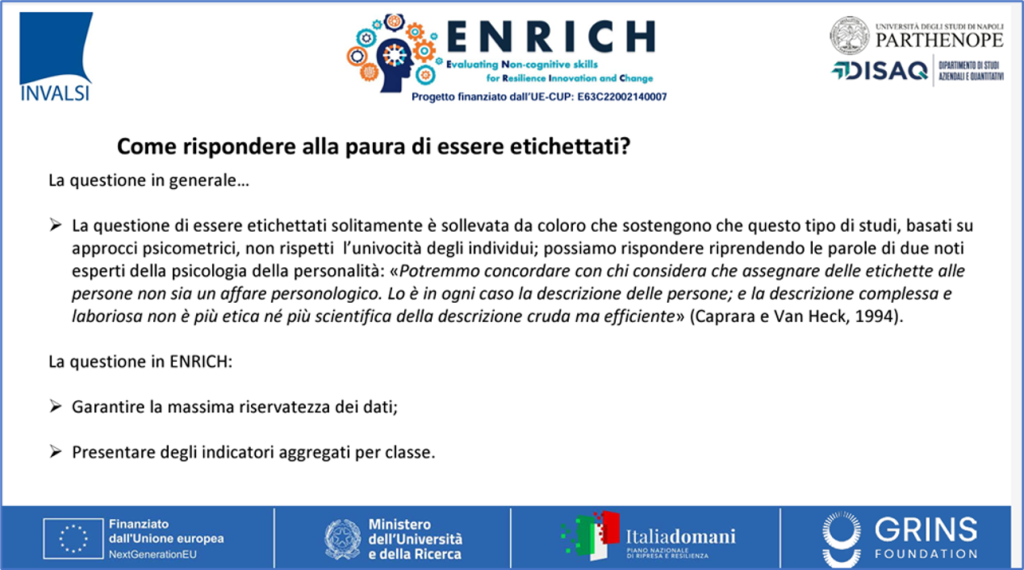
Many people, ourselves included, considered (to say the least) the introduction of psychological-type questions without any public explanation to be inappropriate. The information notice provided to families for the processing of their children's personal data that year did not even mention the addition of the new questions. To our knowledge, there is no scientific precedent, national or international, for mass psychometric-motivational surveys. Today, seven years later, and given the evolution of educational policies, we can consider that first risky attempt as the beginning of a path: that of the standardized measurement of soft skills. Not only are the constructs and objectives of social-emotional learning poorly defined and unconvincing, but they also raise concerns. The psychological, economic, and statistical infrastructure of social-emotional learning is irreparably intertwined with the digital one. The problems concern the protection of highly sensitive data privacy, adequately informed consent from parents, the right to know the purposes, future uses, and the right to deletion of one's data. From an educational point of view, producing statistics from data relating to emotional characteristics and increasing their political weight reinforces pre-existing biases, entrenches conditioning, and risks easily consigning attitudes, traumas, disorders, ambivalences to the realm of pathology or deviance, self-feeding certain visions, normalizations, and simplifications of the self. We know that the lack of scientific consistency and the ethical issues related to the mathematization and standardized measurement of students' character traits will not limit policies on soft skills. This is because the “piecemeal” educational reforms that have been advancing for at least three decades move with the persistence of myth, intertwined with a powerful imaginary, but produce an agenda supported by very concrete material forces and interests (here are some trends on the social-emotional learning market and Ed Tech). For example, in the United States, all 50 states have adopted social-emotional skills in their curriculum frameworks and in 27 states social-emotional skills are part of their standards for all students, from pre-K up to 12th grade. But we also know that there are still spaces and contexts in which to exercise criticism. Among parents and with older students, it is possible to help raise awareness of the risks and dangers of early labeling and profiling in education, attention to privacy, the right to regulated and informed processing of personal data, and distrust of government “armchair psychology” programs. We had proof of this with the public call and the recent intervention precisely on the INVALSI tests and the classification of students, from fragile to excellent, by the privacy guarantor, to which the Institute has not publicly responded. The prospect of building and feeding an increasingly complete database containing detailed information on underage students, the possibility of matching and interoperability between datasets, requires vigilance and concern. The issue of individual labeling is unavoidable. This is INVALSI's response: does it reassure us?
Since then, much has happened in Italy (a brief summary is provided in the appendix to this post) and internationally. The long wave of social-emotional learning with its collection of institutionalized “psychodata” has arrived, and the first to start will be the eleven-year-old students selected from the INVALSI sample. Perhaps, the future questionnaires proposed will be similar to the first “non-cognitive surveys” used by INVALSI in the 2018 student questionnaire.5) Predictions