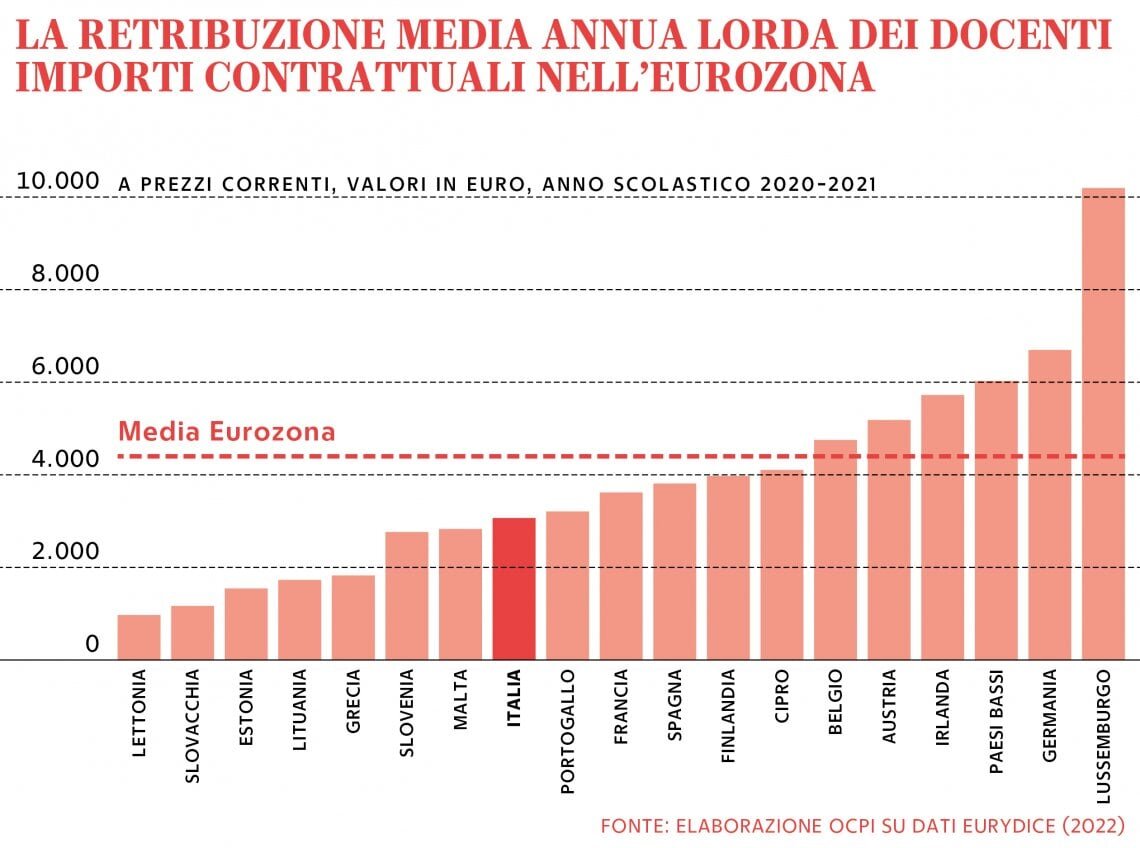
Even after the increases, the salaries of Italian teachers are not aligned with those of their colleagues in other countries. But if you look at purchasing power, it takes little to get close to the best levels on the Continent. In mid-March, the Ministry of Education unlocked another 300 million for the increase in salaries for teachers in Italian schools. In the last six months, teachers (and administrative, technical, and auxiliary staff, Ata) have thus seen their paychecks increase by 124 euros (average value), a figure that is still not enough to close the salary gap compared to other major European countries. According to the publication “Teachers’ and School heads’ salaries and allowances, 2020/2021” by Eurydice, the European education information network under the European Union, in Italy the gross salary starts from a minimum of 24,297 euros and reaches a maximum of 40,597 euros at the end of a career (note: the publication predates the recent increases and therefore cannot take them into account, but the substance does not change much). The pay difference is particularly wide if you look at German standards: it starts from a minimum of 54,129 euros and goes up to 85,589 euros. In Germany, therefore, a teacher's salary is more than double that of an Italian teacher. France is closer to us than to Berlin: it ranges from a minimum of 26,839 euros to a maximum of 50,424 euros. The same goes for Spain, which still remains above Italian levels. The minimum salary is 30,992 euros and the maximum is 49,307 euros. The "richest" teachers in the European Union are found in Luxembourg. Those entering the school system immediately start with a gross salary of 69,076 euros; those close to retirement can reach up to 136,079 euros. Luxembourgish teachers also have a slight tax advantage over Italians: 69,076 euros are subject to the equivalent of an Irpef tax rate of 39% and 136,079 euros to a rate of 40%. In Italy, both of these incomes would fall into the highest bracket, that of 43% which applies from 50,000 euros upwards. Even the lower brackets are less taxed in Luxembourg than in Italy. Eurydice experts note that there are not only large differences in starting salaries but also in the possibilities for growth. Progress ranges from a minimum of 16% in Denmark and Serbia to a maximum of 142% in Cyprus. The average number of years needed to reach the maximum salary ranges from 12 in Denmark to 42 in Hungary. In Ireland, Cyprus, the Netherlands, and Poland, teachers' starting salaries can increase by over 60% in the first 15 years of service. “Even in other countries, the total percentage increase is high but a long period of service is still needed to reach the top of the pay scale - write the Eurydice experts - In Portugal, for example, the final salary is more than double the starting one (115.9%), but teachers only receive it after 34 years of service. In France, to give another example, starting salaries increase by 72% in 35 years of service. There are also countries, and this is also the case in Italy, where teachers need significant seniority to achieve rather modest salary increases. In our country, in fact, teachers' starting salaries can increase by just under 50% only after 35 years of service. More or less the same happens in Spain, where teachers reach the maximum increase of 42% after as many as 39 years of service.” Based on data collected by Eurydice, the CPI Observatory (Italian Public Accounts) of the Catholic University calculated that bringing Italian salaries (30,784 euros on average) up to the European average (44,408 euros) would have an annual cost of 11.6 billion euros. However, this figure could drop significantly if the salary reform took into account purchasing power, that is, the amount of goods and services that can be purchased thanks to the salary. With an annual allocation of 2.9 billion euros from the government, Italian teachers would be able to have the same standard of living as their European colleagues.
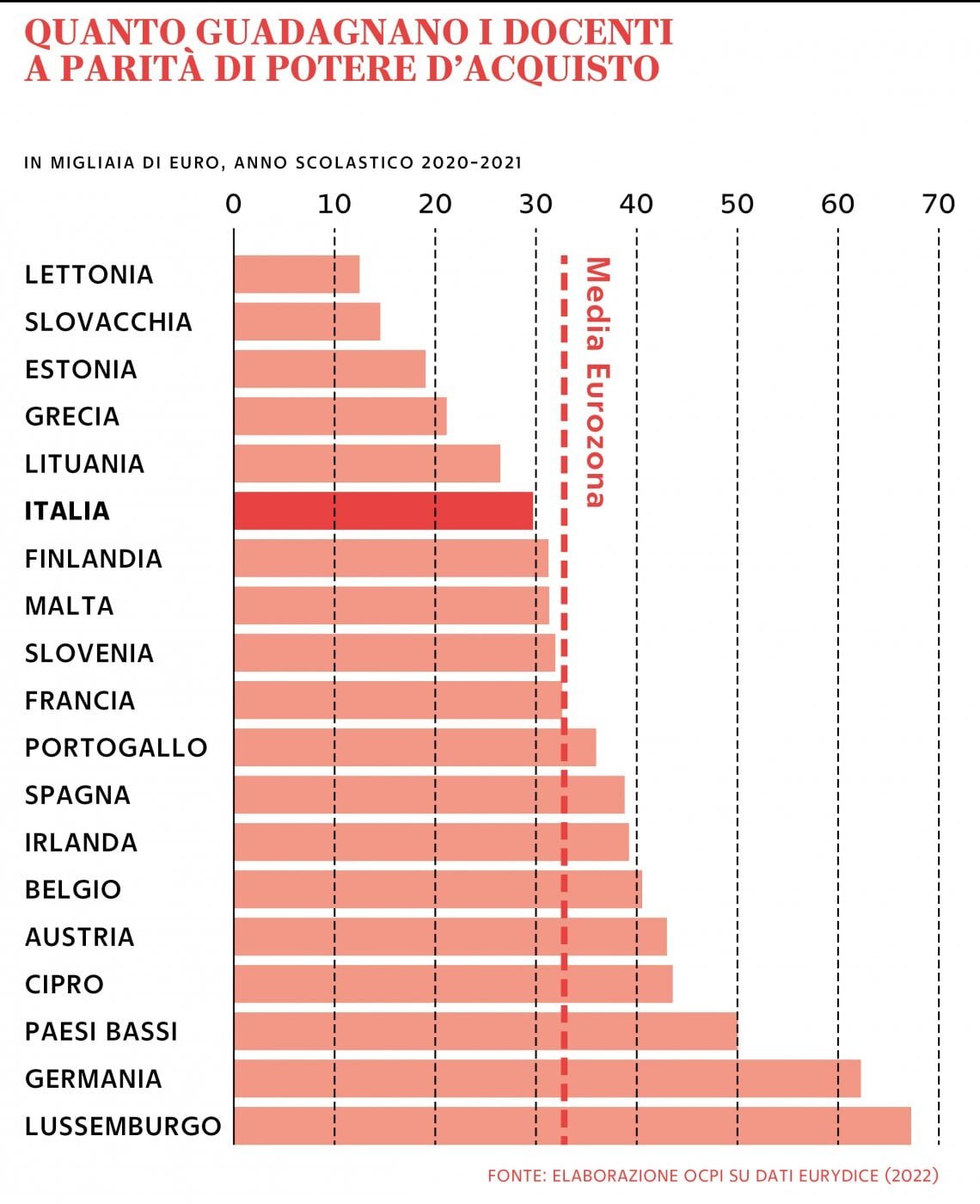
Chart by Silvano Di Meo “If you take into account purchasing power, which is higher in Italy because prices are lower, the pay gap is greatly reduced, down to 3,352 euros,” explains Michela Garlaschi, economist at the CPI Observatory. “In fact, the average gross annual contractual salary of an Italian teacher, adjusted for purchasing power, is 29,669 euros, while that of the Eurozone is 33,021 euros. It is also necessary to consider the diversity of per capita GDP, since a richer country can afford higher salaries. But here there are some surprises because in other countries teachers' salaries in relation to per capita GDP are higher than in Italy, but Italy's per capita GDP is much lower than that of the Eurozone (minus 19.3 percent). The average gross salary of an Italian teacher (30,784 euros) exceeds Italy's per capita GDP (30,040 euros) by only 2.5 percent. In the Eurozone, however, the average salary (44,408 euros) exceeds per capita GDP (35,850 euros) by 23.9 percent.” So, to bring teachers' salaries to the same ratio with per capita GDP as in other countries, the average salary would have to be raised to 37,211 euros, that is, 23.9 percent more than Italy's per capita GDP. The increase would be 6,428 euros (plus 20.9 percent). In this case, the cost of the reform would be 5.5 billion. In short, from whatever angle you approach the issue of Italian teachers' pay, the conclusion, albeit with different nuances, is always the same: teachers in Italian schools are paid less (on average) than their European colleagues.
Chart by Silvano Di Meo Chart by Silvano Di Meo The education information network in Europe, Eurydice, was established by the European Commission and the Member States in 1980 to increase cooperation in the education sector. Since 1995, Eurydice has been an integral part of Socrates, the EU action program in education, since 2007 of the Lifelong Learning Program Llp, and since 2014 it has been part of Erasmus+, the European program for education, training, youth, and sport. Although community-based, Eurydice also involves ten non-EU countries in the Erasmus+ program: Albania, Bosnia and Herzegovina, North Macedonia, Iceland, Liechtenstein, Montenegro, Norway, Serbia, Switzerland, and Turkey. Since 1980 there has been Eurydice, the information network in the education sector