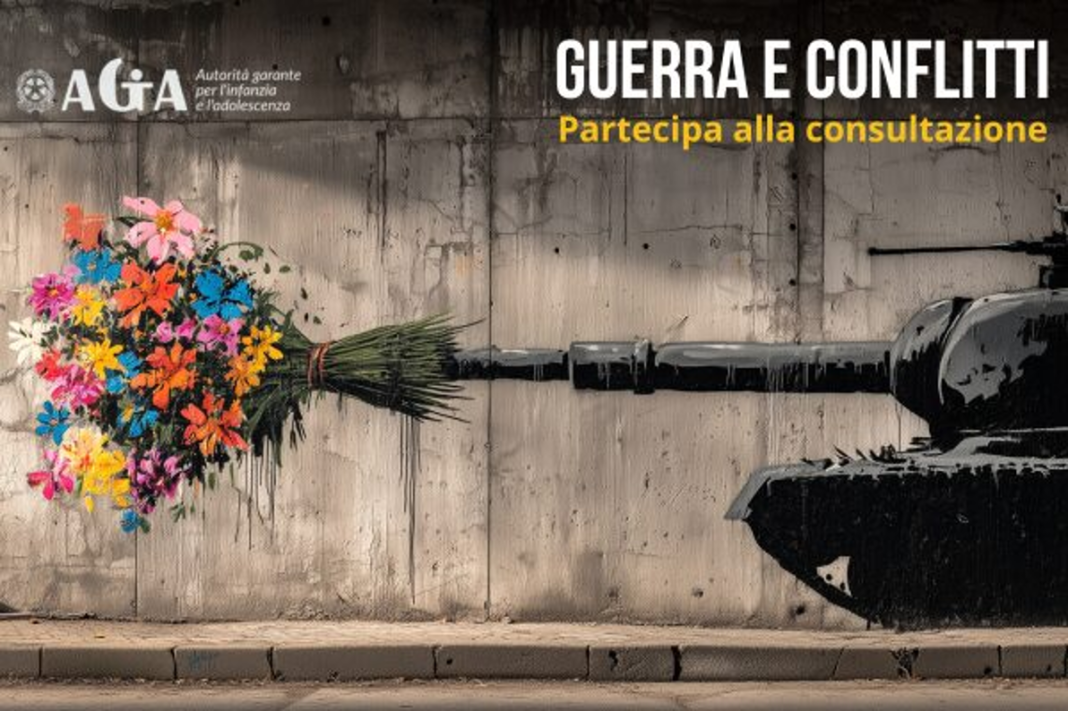
There is renewed discussion about compulsory military service on the international scene. German youth are protesting against the government plan to reintroduce conscription. In Italy, meanwhile, the Guarantor for Childhood and Adolescence has published the first results of a “consultation” aimed at young people aged 14 to 18 entitled “Wars and conflicts”. The Authority, Marina Terragni, says that “the initiative was launched to fill an information gap on the sentiment of adolescents in relation to ongoing conflicts and with the aim of providing institutions with food for thought.”
32 open questions to anyone, not just young people, to which it is also possible to respond repeatedly. Here is the link to participate. Terragni speaks of “food for thought” for institutions. This seems decidedly reductive to us. In what conceptual framework can we place the Guarantor's proposal for Childhood?
Let's proceed by levels.
1) European level. The European Parliament Resolution of April 2, 2025 on the implementation of the common security and defense policy, in the section dedicated to Defense and society, and civil and military preparedness and readiness we read[1]:
(art. 133) a broader understanding is needed, among EU citizens, of threats and security risks in order to develop a shared understanding and alignment of threat perceptions across Europe and to create a global notion of European defense; [..] ; calls on the EU and its Member States to develop educational and awareness programs, especially for young people, aimed at improving knowledge and facilitating debates on security, defense and the importance of the armed forces, and at strengthening the resilience and preparedness of societies to security challenges, while allowing for greater public and democratic scrutiny and control of the defense sector. [..]
(art.134) [the EU] recognizes the crucial importance of citizens in preparing for and responding to crises, in particular the psychological resilience of individuals and the preparedness of families; [..] ; supports a whole-of-society approach to resilience with the active involvement of EU institutions, Member States, civil society and individual citizens in strengthening the Union's security framework.
2) National level. At the Defence Summit 2025 “A safer and more defended Italy” Minister Crosetto stated:
“A comprehensive reorganization of Defense is needed: a model capable of facing tomorrow's challenges and, above all, of changing at the speed required by the present. The proposal I will bring to Parliament is clear: a Defense that can adapt to situations, with appropriate rules capable of ensuring a integrated ecosystem in which Industry, Universities, Research Centers and Defense work in synergy. We have extraordinary energy to do this, but also an internal adversary: the bureaucratic barriers that block and stifle competence. These must be overcome. [..]
Defense can be the engine of this change, positively contaminating other Institutions. It has a dual responsibility: to protect the country today and to build the road that will guarantee a future for the Nation. In this challenge we are all involved: Defense, industry, research, universities. It is a shared responsibility.”
It is in this order of things that we must read the consultation of the Guarantor for Childhood, which has been reported by some critical interventions (see here, here, here, here), which have in fact defined it as an example of “conflict pedagogy disguised as social research.” “Ideological” criticism, replied the Guarantor Authority.
The words “competence” and “resilience”, spoken by Europe and Minister Crosetto, are the ones worth dwelling on. The exhortation to consider Defense, Industry, Research and Universities as a common organism devoted to building a new civil dimension of total mobilization, in the name of security and the danger of imminent war, directly affects the school as well, which is the first link in this chain.
The proposal of the Guarantor Authority is a direct invitation to our students: to develop resilience and a sense of responsibility, but above all to normalize a new idea of a possible future.
First of all, the language, so familiar to those who study and teach. The idea of war as an affective, psychologizing phenomenon; war as an extension of the aggressiveness of individuals and groups, in some ways innate, nourished by deviance or bad habits. The “quarrel as a small war,” the interpersonal conflict assimilated to violence, peace to pacifism and demonstrations (of which the “usefulness” is questioned). There is no trace of historical, economic or political causes, neither of war nor of peace.
Secondly, the methods of the proposal: the multiple-choice test. It is the most appropriate choice. A choice that already constitutes an educational program: the test is the pedagogical form that closes every space and opening at birth, because it forces a predefined selection. The logic of the test teaches obedience, by construction. Once the assumptions of the discussion are fixed, it forces you to select an alternative. Those who do not choose do not participate in the consultation and data collection. Those who do not choose therefore have no voice.
The questions asked are of the type:
In your opinion, are violence and war inherent in human nature? If my country went to war, would I feel responsible and enlist? Do you agree? How do you manage conflicts in your family? Silence and detachment or shouting and tension? How do you react when you argue? Do you raise your voice? Do you attack? Do you listen to the other's reasons? When you argue with someone, can you make peace?
The Guarantor, in the consultation, treats war and peace as if they were soft skills.
Attitudes, predispositions, “character skills,” like those measured by the OECD or by INVALSI. If, on the other hand, today the school certifies “entrepreneurial skills” already in elementary school, perhaps one could also think of measuring students' willingness to go to war or enlist. Always respecting privacy, of course.
Let's try to reason by analogy. Let's compare the question about future expectations that INVALSI proposed in 2018 within the student questionnaire (starting from age 10) to the question about the possible future now proposed by the Guarantor.
What stands out? In less than 10 years, the catalog on the future is updated, expanded and complicated. No longer just a market horizon (consumption, personal desires, success) but now of market and war.
What do you think of if you imagine yourself at war? Will you be more afraid of dying or of compromising your future success plans?
If it does not seem obscene and chilling to us to put on the same level the choice to die and that of not being able to realize one's projects, it is because we have been gradually accustomed, educated to this form of thought and instrumental rationality, for which there are no possible alternatives . The conceptual equivalence is made possible by the statistical equivalence imposed by the same consultation survey tool, which is anything but neutral, which closes off possible futures. But what makes the Guarantor's initiative even more surreal is that it is not even a sensible operation from a statistical point of view: anyone, old or young, can participate in the consultation, even several times. It is embarrassing to talk about analysis on a “provisional sample of 4000 responses”. You can answer pretending to be Mahatma Gandhi or Rambo: young pacifist or fearless warrior. More than obscene, the result is grotesque.
is a placeholder text used in the printing and typesetting industry. Lorem Ipsum has been considered the standard placeholder text since the sixteenth century, when an anonymous printer took a box of type and scrambled it to make a type specimen book. It has survived not only five centuries, but also the leap into electronic typesetting, remaining essentially unchanged. It was popularized in the 1960s with the release of Letraset sheets containing Lorem Ipsum passages, and more recently with desktop publishing software like Aldus PageMaker including versions of Lorem IpsumLorem.